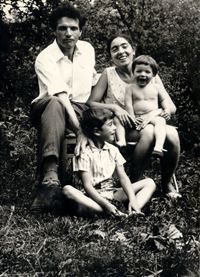
Larissa Miller (born 29.03.1940) is a major Russian poet and essayist, teacher of English and of women's musical gym system named after its creator Russian dancer Lyudmila Alexeeva (
see video including the presentation of Larissa Miller’s own musical gym etudes at the Isadora Duncan’s International Festival in Moscow in 2005), Member of the Union of Russian Writers (since 1979), of the Russian Pen-Center (1992 – 2018) and of PEN-Moscow - Association Free Word (from 2018), author of more than 30 books of poetry and prose, six in translation into English, Dutch and Italian: prose
Dim and Distant Days (Glas, 2000, Transl.: Kathleen Cook & Natalie Roy), and bilingual books of poetry: English-Russian published by Arc Publ. translated by Richard McKane:
Guests of Eternity (2008, Poetry Book Society Recommended Translation),
Regarding the Next Big Occasion (2015),
Fate's Little Pictures (2020), Dutch-Russian
Zestig gedichten (Pegasus, 2011, Transl.: Kees Jiscoot), and Italian-Russian
Grani di felicita (Transeuropa Edizione, 2015, Transl.: Stephano Garzonio).
In 2004 the full collection "Where is it good? Everywhere and nowhere" of 800 of Larissa Miller’s poems written in 1963 – 2002 was published. And after that 20 more books of poems and prose came out in Moscow.
In February 2011 Larissa Miller launched non-stop poetry internet-project "Stikhi gus’kom" (
Poems in single file) which proved to be an unprecedented literary experience: every day in the morning she posts one or two of her poems without repeating them at her personal
LiveJournal Blog. And although this Blog is not an information resource and there are no discussions so typical for internet bloggers the number of the every day regular readers of these posts
increased to 500 – 700, not to mention her poetry addicts at the "mirrors" of this blog: Facebook and others. And there are plenty of responses like e.g.:
"It’s so good to start the day with your poetry";
"one must read your poems in the mornings with a clean soul";
"Larisa Miller’s poems are full of allusions, causing the reader's own images. The impact of her poetry on the nervous system is transcendental". This echoes with the words by Wendy Muzlanova:
"If the English translation is able to stir your emotions, then Miller’s original Russian will rend them... " (Review to "Guests of Eternity",
Scotland-Russia Forum Review, # 21, June 2009).
In 2013 Larissa Miller was awarded
The Arseny and Andrei Tarkovsky Prize. In 1999 she was short-listed for the State Prize of Russian Federation in Literature and Art being nominated to the Prize by famous Literary Almanach "Novyi Mir" which Recommendation says:
"Larissa Miller's poetry is a bright piece of triumph of the Russian speech and of the Russian classical poetry with its exact rhyme, laconicism, with its Pushkin's, Tyutchev's, Fet's enigma. We do not know why this poetry is never out of date, but this is a happy fact of Russian culture, its inalienable wealth. Larissa Miller continues this tradition today...".
Larisa Miller’s essays are about poetry and poets (G. Ivanov, Nabokov, Khodasevich, Tarkovsky, Pasternak...) and a sort of "poems in prose". Her autobiographical novel
Dim and Distant Days embraces half a century of contemporary Russian history: her hungry but happy childhood in post-war Moscow, her mother journalist and her father – also journalist who perished in the II World War in 1942, her first love, etc.
Married in 1962, two sons. Her husband Boris Altshuler is
a physicist and a human rights advocate, during 20 years close ally and friend of Andrei Sakharov, now defending rights of children in New Russia and working in the Theoretical Physics Department of the P. N. Lebedev Physical Institute of the Russian Academy of Sciences.
Read more in
Dim and Distant Days, in the MPT issue
Poetry and the State, and in
Larissa Miller’s interview in 2009.
From the Introductions to
Guests of Eternity:
Richard McKane:
"What, then, made – and makes – Larissa Miller's poetry different? What was it that immediately struck me as a reader and gave me the strong feeling that I could, and should, translate her? ... There is a sensibility in Larissa Miller's poetry that is arresting and draws the reader into her poetry."
Sasha Dugdale:
"Her poems have an exceptionally strong lyrical and sonorous quality and a musicality which is hard to reproduce in English. She is an extraordinary technician. Her often complicated and dense rhymes and rhythms have an effortless quality to them, the ‘unbroken movement’ she observes in Blok’s poems. All this creates the effect of a poetry which stands outside school and fashion and which appears to appeal to infinite worlds and gods..."
(see
here where Sasha Dugdale also traces the bonds of Larissa Miller’s poetry and prose published in
Dim and Distant Days, Glas, 2000).
Wendy Muzhlanova also writes:
"It is a challenge to affix a particular style to Miller’s writing, so let’s not. We have here the physical, the metaphysical, the monotheistic and the pantheistic... Throughout this book, Richard McKane has done a wonderful job of translating Miller’s words...".
From another Review to
Guests of Eternity:
Charles Bainbridge (The Guardian, 18 April 2009):
"These concise, delicate poems, translated with impressive lightness of touch from the Russian, relish the small-scale, the fragile: ‘be quiet and white, white and quiet / at least between the lines, between the work’. They celebrate moments of safety, of exhilaration, when the grander structures, the larger mechanisms of history and politics seem momentarily cast aside...".
Ian McMillan ("Why Arc is still way ahead of the curve", Yorkshire post, May 4, 2012):
"I love to sit in my conservatory with a dual-language Arc book; as Larissa Miller writes, ‘a word is a fire that does not burn the paper...’".
Some Larissa Miller’s poems
From the Guests of Eternity (Transl. by Richard McKane)
* * *
A word is a tear but without salt and moisture.
A word is a fire that does not burn the paper.
The word is conditional, like a pose or a gesture:
they love and perish, yet are fixtures.
Word of hope and word of menaces,
like misery antique poses...
The matter has gone beyond the threshold of pain.
This is the evidence of the living pain:
ten lines rhyming and couplets
with the necessary quantity of pauses and uplets.
* * *
Between the cloud and the pit,
betwixt the birch and the aspen,
between the best of life
and the completely unbearable
under the high vault of the sky
the unstoppable swings
between Bosch’s freaks
and Botticelli’s spring.
* * *
Oh, I believe in yesterday.
The Beatles
They were singing ‘Yesterday’, singing it on the long waves,
singing ‘Yesterday’ ravishingly,
and those beams flared that had long ago burned down.
They were singing that wonderful song about those times,
half-ghostly, it was heavenly there,
where the beams flare and never burn out.
Let our memory preserve that likeness of paradise
from which we can’t ever be thrown out.
* * *
Where are you from?
Like everybody from mother,
from darkness, from the old drama,
from happiness shared with disaster,
from a bearded anecdote.
Where to then?
To somewhere there,
where it's all fresh: flowers and a date
and snow and a Christmas tree at New Year,
and blood, and pain and an anecdote.
* * *
The snow sparkled even in the black years,
the meadows were bright even in the black years,
the spring birds sang,
the vernal passions boiled.
When they led away the innocent under guard
the cherry trees were blossoming tenderly,
the waters of the lakes rippled
in those black, black years.
* * *
Thank you, State,
thank you, many thanks
for not destroying everyone,
for not hacking to death everyone's flesh,
for not corrupting everyone's soul,
for not defiling all the dry land,
for not polluting all the waters,
and that not all your children are monsters.
1990
New poems (2010 – 2012, Transl. by David Anderson & Ilya Altshuler)
* * *
And Russia has never learned her lessons,
And her wounds she has never really healed,
And any of them got inflamed, bleeding,
And the gnawing resentment, and guilt as a bone sticking in the throat.
New Age for Russia has not become new epoch.
She is swearing with dirty words, she is raging, and coughs up blood.
* * *
Quiet, empty – I naively thought.
At a closer look – Oho, life of every kind:
Ants and midges, beetles, worms,
Various little wings, whiskers, eyes, feelers.
Oh, what a stir is happening everywhere.
It has an immediate relationship with me.
After all, when I too appeared on earth,
I set myself to make a lot of contacts.
Since it suited me to make my home on earth.
I too started to worry and shift about.
I too am dependent on God knows whom
I too do not know which is my last day.
Then why do I walk, in a daze of blue distance,
And slaughter my kin with my sandals?
* * *
No-one owes you anything, you know.
You want a party? Fix it yourself.
You long for a song? Compose it yourself
And captivate everyone round you.
You pine for the light? To cheer the world up
Light it up yourself. There’s no other way.
* * *
Why count your years?
Better, like them, to fly.
‘How old are you ?’ – they ask. – ‘I didn’t count.
You know, I simply flew around
And sometimes I would take
Wings from the flying years.’